Disclosure: This post contains affiliate links. As an Amazon Associate, TBB 787 earns from qualifying purchases at no extra cost to you.
Introduction: A Name Synonymous With Genius
Say the word “genius” in virtually any language, and the face that springs to mind — wild white hair, warm brown eyes, a slightly bemused smile — is almost certainly Albert Einstein’s. No scientist in history has captured the popular imagination the way Einstein did, or cast as long a shadow over the culture and science of the century that followed his work. He is the patron saint of brilliant eccentrics, the secular prophet of the scientific age, the man who looked at the universe and saw it whole — and then had the audacity to explain it. This is his story.
Early Years: The Child Who Came Late to Talking
Albert Einstein was born on March 14, 1879, in Ulm, in the Kingdom of Württemberg in the German Empire. He was the first child of Hermann Einstein, a salesman and engineer, and Pauline Koch. From the very beginning, Albert was an unusual child. He was notably late to begin speaking — he didn’t form full sentences until the age of two or three, and spoke so slowly and haltingly that his parents feared he might have a developmental disability. His sister Maja later recalled that even as a young boy, he would pause at length before answering even simple questions, as though every response required deep consideration.
The family moved to Munich when Albert was an infant, and it was there that his earliest intellectual interests took shape. He showed little interest in the rough-and-tumble games that occupied other boys his age, preferring solitary pursuits: building elaborate structures with blocks, solving puzzles, and playing the violin, an instrument his mother insisted he learn and which became a lifelong companion. At the age of five, his father gave him a magnetic compass as a gift, and the young Einstein was transfixed. The needle moved — but nothing was touching it. Some invisible force was acting on it through empty space. It was, by his own later account, the moment that first ignited his lifelong obsession with the hidden forces governing the physical world.
School: A Rebel in the Classroom
Einstein’s relationship with formal education was famously complicated. He attended the Luitpold Gymnasium in Munich, where he excelled in mathematics and physics but chafed under the school’s rigid, authoritarian teaching style. He resented rote memorization and the expectation of passive compliance, preferring to question, debate, and understand the underlying logic of things. His teachers found him difficult. One reportedly told him he would “never amount to anything.” He failed the entrance examination to the Swiss Federal Polytechnic in Zurich on his first attempt — though primarily because his French language skills were inadequate, not his mathematics, in which he scored brilliantly.
He spent a year at the cantonal school in Aarau, Switzerland — a place with a far more progressive, Socratic teaching philosophy that Einstein described as transformative — and passed the Polytechnic entrance exam on his second attempt. He graduated in 1900 with a teaching diploma in mathematics and physics. But his troubles with authority followed him: his professors at the Polytechnic found him too independent, too willing to skip lectures and pursue his own interests, and declined to recommend him for academic positions after graduation. For two years, Einstein struggled to find any job at all in his chosen field.
The Patent Office and the Miracle Year
In 1902, through the assistance of a classmate’s father, Einstein secured a position as a Technical Expert (Third Class) at the Swiss Patent Office in Bern. The job was, in retrospect, a gift disguised as a setback. The work was straightforward enough to leave his mind free for theoretical physics. He could evaluate patent applications quickly, then spend the remainder of his mental energy on the deepest questions in science. He spent seven years at the patent office, and they were the most productive years of any physicist’s life.
The year 1905 — Einstein’s annus mirabilis, his miracle year — stands as perhaps the most astonishing single year of intellectual achievement in scientific history. Einstein, working alone without laboratory equipment, professional colleagues, or institutional support, published four papers in the prestigious journal Annalen der Physik, each of which would, by itself, have been sufficient to secure a permanent place in the history of science.
His first paper explained the photoelectric effect — the fact that light striking a metal surface ejects electrons — by proposing that light travels not as a continuous wave but as discrete packets of energy he called quanta (later renamed photons). This work, which directly contradicted the classical wave theory of light championed by Maxwell, would eventually earn Einstein the Nobel Prize in Physics in 1921. His second paper provided the first rigorous mathematical proof of the existence of atoms, using statistical analysis of Brownian motion (the jittery movement of tiny particles suspended in a liquid) to calculate the size and number of atoms with remarkable accuracy — helping finally silence the few scientists who still doubted atoms were real. His third paper introduced the Special Theory of Relativity — a complete reconception of space, time, and motion that swept away two centuries of Newtonian mechanics. And his fourth paper derived the most famous equation in all of science: E = mc².
Special Relativity: Time Is Not What You Think It Is
To understand why Special Relativity was so revolutionary, you need to appreciate what it replaced. Since Newton, physicists had operated on the assumption that space and time were absolute — fixed, universal, the same for every observer everywhere. A second was a second, a meter was a meter, regardless of whether you were standing still or moving at enormous speed. Einstein showed this was wrong. At high velocities — approaching the speed of light — time slows down, space contracts, and mass increases. Two observers moving relative to each other will genuinely, measurably disagree about the length of a moving object and the duration of an event. There is no “true” time or “true” space — only space-time, a unified four-dimensional fabric in which the measurements of space and time are inextricably linked.
The famous equation E = mc² emerged from this framework. It states that energy and mass are equivalent — that mass is, in essence, frozen energy, and that an enormous amount of energy is locked up in even a tiny amount of matter (c, the speed of light, is approximately 300,000 kilometers per second, so c² is an inconceivably large number). This insight would ultimately lead, with tragic irony, to both the promise of nuclear power and the horror of the atomic bomb.
📚 Essential Einstein Books
Einstein’s ideas can be challenging but are endlessly rewarding. These books will help you understand both the man and his science:
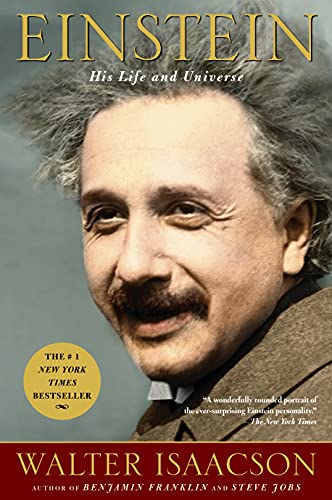
- 📖 Einstein: His Life and Universe by Walter Isaacson — The definitive modern biography of Einstein, written with Isaacson’s trademark narrative drive and intellectual clarity. Based on newly opened archives and private papers, this is the most complete and readable account of Einstein’s life ever written. Absolutely essential.
- 📖 Relativity: The Special and General Theory by Albert Einstein — Einstein’s own explanation of his theories, written for a general audience. Remarkably accessible from the man himself. A unique experience — reading the greatest scientist of the 20th century explain his own greatest ideas.
- 📖 The Theory of Everything: The Origin and Fate of the Universe by Stephen Hawking — Hawking traces the development of cosmological theory from Newton through Einstein and beyond, providing brilliant context for understanding Einstein’s lasting impact on physics.


General Relativity: Gravity Is Not a Force
Special Relativity dealt with objects moving at constant velocities. For the next decade, Einstein worked to extend his theory to include accelerating objects and gravity — the result was General Relativity, published in 1915, which Einstein himself considered his greatest achievement. The theory’s central claim is breathtaking in its simplicity and audacity: gravity is not a force at all. It is a curvature of space-time caused by mass and energy. Large masses — like the Sun — warp the fabric of space-time around them, and other objects (like the Earth) follow curved paths through that warped space-time. We experience this as gravitational attraction.
The most dramatic confirmation of General Relativity came in 1919, when British astronomer Arthur Eddington led an expedition to observe a total solar eclipse and measured the bending of starlight passing near the Sun. Einstein’s theory predicted precisely how much the Sun’s mass would curve space-time and deflect the light — and Eddington’s measurements confirmed the prediction with startling accuracy. The announcement made global headlines. Overnight, Einstein became the most famous scientist in the world — a celebrity physicist in an era before celebrity scientists were a common phenomenon.
The Quantum Debate: Einstein vs. Bohr
Ironically, the man who helped launch the quantum revolution with his 1905 paper on the photoelectric effect became one of quantum mechanics’s most stubborn critics as the theory developed in the 1920s. Einstein was deeply troubled by the probabilistic nature of quantum mechanics — the idea that the universe is fundamentally random at the subatomic level, that a particle’s position or momentum is genuinely indeterminate until it is measured. “God does not play dice with the universe,” he famously declared to his friend and rival Niels Bohr. The two giants of 20th-century physics engaged in a decades-long debate that has become legendary in the history of science.
Einstein devised a series of brilliant thought experiments designed to expose flaws in quantum theory’s logical foundations. Bohr countered each one with equal brilliance. The debate was never fully resolved in Einstein’s lifetime, and it has continued ever since. Most physicists today believe Bohr was right and Einstein was wrong on this specific question — quantum mechanics has proven spectacularly successful as a predictive framework, and experimental tests of Bell’s theorem have confirmed that the “spooky action at a distance” that Einstein found most objectionable (quantum entanglement) is real. But Einstein’s critiques refined and sharpened quantum theory in ways that proved enormously productive.
Exile and the Atomic Bomb
When Adolf Hitler rose to power in Germany in 1933, Einstein — who was Jewish and internationally famous — was in the United States on a visiting professorship. He never returned to Germany. He joined the newly founded Institute for Advanced Study in Princeton, New Jersey, where he would spend the rest of his life. In 1940, he became an American citizen.
In 1939, alarmed by reports that Nazi Germany might be pursuing an atomic bomb, Einstein signed a letter to President Franklin D. Roosevelt — drafted largely by physicist Leo Szilard — warning of the potential for a weapon of unprecedented destructive power and urging the United States government to fund its own research. This letter helped trigger the Manhattan Project. Einstein himself did not work on the bomb — his pacifism and his status as a former German national made it politically complicated — but he always felt a deep sense of personal responsibility for having set the process in motion. After Hiroshima, he said: “I could burn my fingers that I wrote that first letter to Roosevelt.”
Final Years and the Unified Field Theory
Einstein spent the last decades of his life in a largely solitary pursuit: the search for a Unified Field Theory that would reconcile General Relativity with quantum mechanics, merging all the forces of nature into a single mathematical framework. He never found it. Most physicists of the era believed he was chasing a phantom — that the reconciliation of gravity and quantum mechanics required new conceptual tools that Einstein was temperamentally unwilling to adopt. The problem remains unsolved today and stands as one of the central challenges of modern theoretical physics.
He died on April 18, 1955, in Princeton, from an aortic aneurysm. He was 76. He refused surgery, telling his doctors: “It is tasteless to prolong life artificially. I have done my share, it is time to go.” His brain was removed by the pathologist who performed his autopsy — without explicit permission — and studied for decades by researchers hoping to identify the physical basis of his extraordinary intelligence. His ashes were scattered at an undisclosed location, in accordance with his wishes.
Einstein’s Enduring Legacy
The legacy of Albert Einstein is almost impossible to overstate. General Relativity is the foundation of modern cosmology — our understanding of the Big Bang, black holes, the expansion of the universe, gravitational waves (detected for the first time in 2015, exactly a century after Einstein predicted them), and the ultimate fate of the cosmos all rest on Einstein’s framework. GPS satellites require relativistic corrections to their clocks to maintain accuracy — without General Relativity, GPS would accumulate errors of miles per day. Laser technology, solar cells, digital cameras, and LED lights all trace their technological lineage to Einstein’s quantum work. E = mc² underlies nuclear power and nuclear medicine. He is present in virtually every modern technology you use.
Beyond physics, Einstein modeled for the world what it means to hold fast to one’s convictions in the face of opposition, to maintain intellectual humility alongside fierce confidence, to be simultaneously a citizen of the world and a dedicated servant of truth. He was a pacifist who signed a letter that helped build the most destructive weapon in human history, and he carried that contradiction with honest anguish. He was a brilliant scientist who understood the social responsibilities of science. He remains, 70 years after his death, the face of genius — and one of the most inspiring human beings who ever lived.
🌟 More Einstein Essentials
- 🔭 National Geographic Kids: Albert Einstein (Readers) — A wonderful introduction to Einstein for younger readers. Engaging, accurate, and beautifully illustrated.
- 🎲 Einstein: A Board Game of Physics Strategy— Challenge your mind with physics-themed strategic thinking. A great gift for science enthusiasts.

- EINSTEIN THE GAME: Team up and channel your inner Einstein as you race to win puzzle challenges!
- FUN CHALLENGE: Think fast, answer first, and win key spaces on the board while also trying to block the other team. The …
- GREAT GIFT IDEA: A great item for any fan of creative thinking brain teaser puzzles.
$24.00 - 📐 The Princeton Companion to Mathematics — For those inspired by Einstein to go deeper into the mathematics underlying modern physics. A comprehensive and rewarding reference.


Conclusion
Albert Einstein stands apart even among the greatest scientists. Newton gave us the laws of motion and gravity. Darwin gave us evolution. Maxwell gave us electromagnetism. But Einstein did something rarer still: he reconstructed the very foundations of space, time, matter, and energy, and replaced them with something far stranger and more beautiful than anyone had imagined possible. He did it not with an army of collaborators or institutional support, but sitting alone at a patent examiner’s desk in Bern, Switzerland, asking questions so deep that the universe could not refuse to answer. His life is a testament to the power of curiosity, the importance of independence of thought, and the extraordinary beauty that awaits anyone willing to look at the world with truly open eyes. E = mc² is not just an equation. It is a love letter from one of history’s most remarkable minds to the universe that produced him.
This post contains affiliate links. As an Amazon Associate, TBB 787 earns from qualifying purchases. Thank you for supporting our work!
Read more: our picks for the best books about inventors and scientists, including Walter Isaacson’s Einstein biography.