Disclosure: This post contains affiliate links. If you purchase through these links, we may earn a small commission at no extra cost to you.
Introduction: The Man Who Lit the World
Nikola Tesla is arguably the most underappreciated genius in the history of modern science. While Thomas Edison became a household name celebrated in every school textbook, Tesla — the man whose alternating current (AC) electrical system powers virtually every home, factory, office, and device on Earth — spent his final years in near poverty, forgotten and largely dismissed by the scientific establishment. Yet today, more than 80 years after his death, Tesla is experiencing a remarkable renaissance. His name graces the world’s most celebrated electric vehicle company, and millions of people recognize him as the true father of the modern electrical age. This is the extraordinary, turbulent, inspiring, and deeply tragic story of Nikola Tesla: visionary inventor, electrical pioneer, and one of history’s greatest minds.
Early Life: Born in the Shadow of a Lightning Storm
Nikola Tesla was born on July 10, 1856, in Smiljan, a village in the Serbian community of the Austrian Empire (present-day Croatia). His birth itself seemed to foreshadow his future obsession with electricity — according to family legend, he was born precisely at midnight during a fierce lightning storm. When the midwife declared this an ill omen, his mother, Georgina “Đuka” Mandić, reportedly responded: “He will be a child of light.” No truer words were ever spoken.
Tesla was the fourth of five children born to Milutin Tesla, a Serbian Orthodox priest and poet, and Đuka Tesla, a woman of remarkable intelligence who, despite never receiving a formal education, memorized entire books and invented small household appliances in her spare time. Tesla often credited his mother as his greatest inspiration, writing that her hands never rested. It is from her that he inherited his extraordinary memory and his gift for invention.
From the earliest age, Tesla displayed signs of the exceptional intellect that would define his life. He performed complex calculations in his head with breathtaking speed, committed lengthy passages of poetry to memory after a single reading, and developed an almost photographic visual imagination — a quality he would later describe as a form of mental laboratory where he could build, test, and refine inventions entirely within his mind. “My method is different,” he would later explain. “I do not rush into actual work. When I get an idea, I start at once building it up in my imagination, and make improvements and operate the device in my mind.”
His childhood was also marked by early tragedy. His brother Dane — considered by the family to be the more gifted of the Tesla sons — died in a horse-riding accident when Nikola was five years old. Tesla would later write that he believed his own brilliance was partly a response to the grief of his parents, a burning desire to compensate for the loss of Dane and to prove himself worthy of their love and attention.
Education: A Brilliant Mind Forged in Struggle
Tesla attended the Higher Real Gymnasium in Karlovac, where he completed the four-year curriculum in just three years. His mathematics teacher was so impressed by his ability to perform integral calculus mentally that he initially suspected Tesla of cheating. Tesla was fascinated by demonstrations of electricity performed in the classroom, and these early encounters with electrical phenomena planted the seed of a lifelong obsession.
After graduating in 1873, Tesla returned to Smiljan, where he contracted cholera and nearly died. During his long convalescence, he made a deal with his reluctant father: if he recovered, his father would allow him to pursue engineering rather than the priesthood. Milutin Tesla had always envisioned his son following him into the Orthodox clergy, but Nikola’s passion was unmistakably technical, not theological.
In 1875, Tesla enrolled at the Austrian Polytechnic in Graz on a Military Frontier Scholarship. He threw himself into his studies with monastic devotion, often studying 20 hours a day and earning the highest grades possible in every course. But the intensity of his efforts took a toll: by his second year, Tesla had lost his scholarship and fallen into a gambling addiction. He left without a degree — a failure that would haunt him for years.
The Eureka Moment: Conceiving the AC Motor
In 1881, Tesla moved to Budapest, Hungary. While walking in the city park with a friend, reciting verses from Goethe’s Faust, Tesla was suddenly struck by a vision. The concept of a rotating magnetic field — the foundational principle of the alternating current induction motor — crystallized in his mind with complete clarity. He grabbed a stick and drew the design in the dirt. “The idea came like a flash of lightning,” he later wrote, “and in an instant the truth was revealed.”
This was the insight that would change the world. At the time, electrical power relied almost entirely on direct current (DC), championed by Thomas Edison. DC worked reasonably well for short distances but lost enormous energy over long transmission lines. Tesla’s AC system could transmit electricity over hundreds of miles with minimal loss, making it practical to build central power stations that could serve entire cities and regions.
Meeting Edison and the Birth of a Rivalry
In 1882, Tesla began working for the Continental Edison Company in Paris. In 1884, armed with a glowing letter of recommendation, he sailed to New York City to meet Edison himself. He arrived with almost nothing — four cents in his pocket and a mind crackling with world-changing ideas. Edison hired him immediately. But from the start, their relationship was fraught with tension. Edison was a pragmatist who worked through trial and error. Tesla was a theorist who could envision the completed solution before a single component was built.
The final rupture came when Edison allegedly promised Tesla $50,000 if he could improve the efficiency of his DC dynamos. Tesla worked around the clock for months and succeeded, dramatically improving the machines. When he asked for the promised payment, Edison reportedly laughed and said: “Tesla, you don’t understand our American humor.” Tesla resigned immediately.
The War of Currents
After a humiliating period digging ditches for $2 a day, Tesla found new backers and founded the Tesla Electric Company in 1887. His work came to the attention of industrialist George Westinghouse, who purchased his AC patents for a reported $60,000. What followed was the legendary “War of Currents.” Edison launched a vicious campaign to discredit AC power, hiring men to publicly electrocute animals with AC current to associate Tesla’s technology with danger and death.
But the facts were on Tesla’s side. In 1893, the World’s Columbian Exposition in Chicago was lit entirely by AC power, dazzling 27 million visitors. Two years later, Tesla and Westinghouse built the first major hydroelectric power plant at Niagara Falls, transmitting AC electricity 26 miles to Buffalo, New York. The War of Currents was over. Tesla had won.
📚 Recommended Reading: Tesla’s Incredible Story
These books will take you deep into Tesla’s world and the electrical revolution he created:
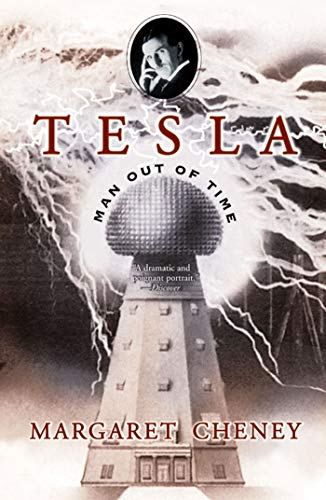
- 📖 Tesla: Man Out of Time by Margaret Cheney— The definitive Tesla biography. Cheney captures his brilliance, eccentricities, and tragic isolation with rare depth and empathy. Widely considered the single best book on Tesla.
 $5.00
$5.00 - 📖 My Inventions: The Autobiography of Nikola Tesla — Tesla in his own words. Fascinating, eccentric, and deeply revealing. Essential reading for any Tesla admirer.
- 📖 Empires of Light: Edison, Tesla, Westinghouse by Jill Jonnes — The most gripping account of the War of Currents ever written. Brings the era alive with novelistic energy and meticulous research.


Colorado Springs and Wireless Power
By the late 1890s, Tesla turned his attention to what he believed would be his greatest achievement: the wireless transmission of electrical power on a global scale. In 1899, he traveled to Colorado Springs, building a massive laboratory equipped with transformers capable of generating millions of volts. He produced artificial lightning bolts 130 feet long — still the longest man-made lightning discharges ever created. He developed his “World System” concept: a global network of towers that would transmit not just information but electrical power wirelessly to any point on Earth, making energy free and universally available.
Wardenclyffe Tower: The Dream That Collapsed
Backed by J.P. Morgan, Tesla began building his World System in 1901 on Long Island. The Wardenclyffe Tower rose 187 feet into the air, topped by a 55-ton metal sphere, with an underground root system extending 120 feet into the earth. But Morgan’s interest was in wireless communications — not free power. When Tesla revealed his full vision, Morgan reportedly asked: “Where can I put the meter?” He cut off funding. Other investors withdrew. In 1917, the U.S. government demolished the unfinished tower, selling the rubble to pay Tesla’s debts. It was one of the most heartbreaking moments in the history of science.
Later Life: Decline and Isolation
After Wardenclyffe, Tesla’s fortunes declined steadily. He continued inventing — demonstrating one of the world’s first radio-controlled vehicles in 1898, contributing to radar technology, and developing the revolutionary Tesla Turbine. But financially, he never recovered. His mental health deteriorated, and he developed severe obsessive-compulsive tendencies: a phobia of round objects, an obsession with the number three, and an extreme sensitivity to light and sound. He became a recluse, living in New York hotels and developing a famous bond with the pigeons he fed in Bryant Park. He never married, believing romantic attachment was incompatible with the life of a dedicated inventor.
Death and Vindication
Tesla died alone on January 7, 1943, in Room 3327 of the Hotel New Yorker. He was 86. He died in debt, his royalties surrendered, his patents largely expired, his contributions not yet fully acknowledged by the world he had done so much to create. In a sad coda, government agents seized his papers, apparently concerned his notes on directed-energy weapons might have military value.
History has been far kinder. The SI unit of magnetic flux density — the tesla — bears his name. His AC system remains the global standard. His radio patents were upheld by the U.S. Supreme Court the same year he died. Elon Musk’s Tesla, Inc. carries his name as an explicit tribute. His Wardenclyffe vision lives on in wireless charging and emerging power-beaming technologies.
⚡ Great Tesla Products for Enthusiasts
- 🔬 Build Your Own Mini Tesla Coil Kit— Experience Tesla’s most iconic invention firsthand. Perfect for science enthusiasts, students, and curious minds of all ages. A brilliant demonstration of wireless energy transfer in action.
- Child’s First Science Building Kit – Introduce your child to science with their very first DIY kit. Easy to assemble and…
- Complete STEM Kit with Video Tutorial – This STEM kit features a sleek, shatterproof clear acrylic case so kids can see …
- Be a Cool Little Scientist – Turn a pile of parts into a one-of-a-kind science craft and feel the pride of building some…
$38.80 - 🎨 Nikola Tesla: A Life From Beginning to End — A concise, well-researched overview ideal for readers who want a fast but comprehensive introduction to Tesla’s life and inventions.
- 📐 Tesla Inspired Science Experiment Set— A wonderful educational gift set exploring electricity and magnetism, inspired by Tesla’s discoveries. Perfect for curious young scientists.
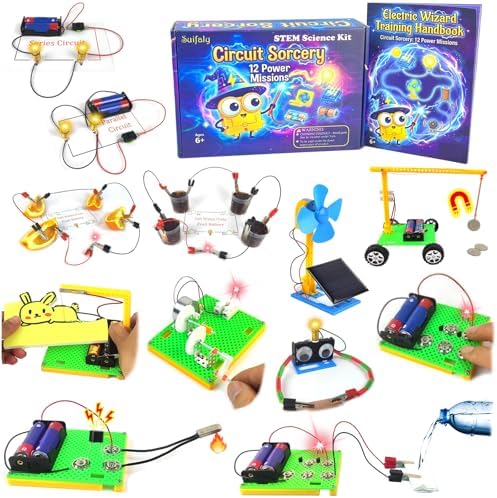
- 12 EXCITING POWER MISSIONS: Embark on a thrilling journey through the Electric Magic Academy! From illuminating mysterio…
- 4 SYSTEMATIC TRAINING MODULES: Step away from disorganized experiment sets. Our kit is professionally structured into 4 …
- COMPREHENSIVE GUIDE & TROUBLESHOOTING: The “Electric Wizard Training Handbook” offers more than just instructions. It pr…
$22.49


Conclusion: The Light He Left Behind
Nikola Tesla’s life is one of the most extraordinary stories ever told: a child of peasant stock who became the architect of the modern world, who lit the globe and then died in darkness, whose ideas were dismissed during his lifetime and vindicated after his death. He reminds us that genius is rarely recognized in its own moment, that the truly transformative ideas are often the ones that seem most impossible, and that the measure of a life is not the wealth it accumulates but the light it leaves behind. Nikola Tesla, who was born in a lightning storm and spent his life trying to harness the sky, left behind more light than almost anyone in history. The next time you flip a light switch, remember the man who made it possible.
This post contains affiliate links. As an Amazon Associate, TBB 787 earns from qualifying purchases. This helps support our mission at no extra cost to you.
Read more: our picks for the best books about inventors and scientists, including the best Tesla biographies.