Affiliate Disclosure: This post contains Amazon affiliate links. TBB 787 earns a commission on qualifying purchases at no extra cost to you. All content is thoroughly fact-checked against primary historical sources.
Introduction: The Man Who Invented the Question "Can Machines Think?"
Every time you unlock a phone, ask a chatbot a question, or watch a computer beat a chess grandmaster, you are living inside an idea that one British mathematician described on paper in 1936 — years before a single electronic computer existed anywhere on Earth. Alan Turing did not just help build the first computers. He defined, mathematically, what a computer even is, before the word meant anything close to what it means today. He then used that same mind to help break the supposedly unbreakable Nazi Enigma code during World War II, an achievement historians credit with shortening the war by as much as two years and saving millions of lives. It is a strange, almost invisible kind of immortality — an idea so thoroughly absorbed into the fabric of daily life that almost no one who benefits from it stops to ask where it came from. Few figures in modern history did so much, so quietly, for so long before the world caught up to what they had actually done.
And yet Alan Turing died at 41, prosecuted by the very government he had helped save, chemically castrated as a court-ordered "treatment" for being gay, stripped of his security clearance, and largely written out of public memory for decades because his wartime work remained classified until long after his death. It is one of the great injustices of the twentieth century, attached to one of its greatest minds. This is the full story of Alan Turing: the codebreaker, the founder of computer science, and the man Britain spent sixty years learning how to properly honor.
Early Life: A Strange, Brilliant Childhood
Alan Mathison Turing was born on June 23, 1912, in Maida Vale, London, to Julius and Ethel Turing. His father worked in the Indian Civil Service, which meant Alan and his older brother John spent much of their early childhood being raised by a retired Army couple in England while their parents traveled between Britain and India — a common but emotionally difficult arrangement for children of colonial civil servants at the time.
From an early age, teachers and family members noted that Alan was unusually independent-minded, more interested in discovering ideas for himself than memorizing what he was told. At his boarding school, Sherborne, this trait did not always serve him well within a rigid, classics-focused British education system that valued Latin composition over mathematical originality. His headmaster once wrote that if Turing was "to be solely a Scientific Specialist, he is wasting his time at a Public School" — a remarkably tone-deaf assessment of a student who, at 16, was already reading and understanding Einstein’s papers on relativity well enough to question minor points in them.
At Sherborne, Turing formed a close friendship with a fellow student named Christopher Morcom, who shared his passion for science and mathematics. Morcom’s sudden death from tuberculosis in 1930 devastated Turing and, by his own later reflection, deepened his interest in questions of mind, consciousness, and whether human thought could ever be fully explained in physical or mechanical terms — questions that would define his entire career. Biographers consistently point to this period as the emotional root of the questions about mind and mechanism that would occupy him for the rest of his intellectual life.
Cambridge and the Birth of the "Turing Machine"
Turing won a scholarship to King’s College, Cambridge, in 1931, where he studied mathematics and was elected a fellow at just 22 years old on the strength of his dissertation on probability theory. But the work that would change history came in 1936, when the 24-year-old Turing published a paper with a dry, unassuming title: "On Computable Numbers, with an Application to the Entscheidungsproblem."
Buried inside that paper was one of the most important ideas of the twentieth century. Turing described a theoretical device — now called a "Turing machine" — that could read and write symbols on an infinite tape according to a set of simple rules, and argued that such a device could, in principle, compute anything that is mathematically computable at all. This was not a physical machine; it was a thought experiment, a mathematical proof. But it quietly defined the theoretical limits and possibilities of every computer that would ever be built, decades before the technology to build one existed. Computer scientists today still refer to the abstract concept of a general-purpose, programmable computing device as "Turing complete" — a direct legacy of this single 1936 paper.
The paper also introduced the concept of a "universal machine" — a single machine capable of simulating any other Turing machine, given the right instructions. This is, in essence, the foundational idea behind every modern computer and smartphone: a single piece of hardware that can run any software, rather than needing a different physical machine built for every different task. Turing had described the computer before anyone had built one.
Bletchley Park: Breaking the Unbreakable Enigma Code
When Britain declared war on Germany in September 1939, Turing was recruited almost immediately to Bletchley Park, the secret headquarters of Britain’s wartime codebreaking operation. His target was the Enigma machine — a German electromechanical cipher device that scrambled messages into what its operators believed was a mathematically unbreakable code, with roughly 159 quintillion possible settings for a given message.
Turing did not solve Enigma alone — Polish mathematicians had already made crucial early breakthroughs before the war, which they shared with British intelligence just weeks before Poland fell to Germany. But Turing led the British effort that turned those early insights into a working, industrial-scale solution. He designed an electromechanical device called the Bombe, which could rapidly test thousands of possible Enigma settings per hour, searching for logical contradictions that would eliminate incorrect settings until the correct one emerged. By early 1940, Bombes at Bletchley Park were breaking German military Enigma traffic on a regular, and eventually near-daily, basis. It was, in every real sense, a race against time: every day a message went unbroken was a day German U-boats and troop movements operated with a decisive informational advantage over the Allies trying to track them.
The intelligence this produced — codenamed Ultra — gave Allied commanders an extraordinary window into German military planning, from U-boat positions in the Battle of the Atlantic to troop movements ahead of the Normandy landings. Historian and Bletchley Park codebreaker Sir Harry Hinsley later estimated that Ultra intelligence shortened the war in Europe by at least two years, potentially saving millions of lives on all sides. Winston Churchill reportedly told King George VI that Turing had made the single biggest individual contribution to Allied victory of anyone in the war — a claim historians broadly still credit today, even accounting for the collaborative nature of the codebreaking effort. The scale of that claim is worth sitting with: a single, quiet mathematician working largely out of public view may have had a greater direct impact on the war’s outcome than most of the generals whose names actually appeared in newspaper headlines at the time.

Andrew Hodges’ definitive, exhaustively researched biography — the book that inspired The Imitation Game. The single best starting point for anyone who wants the full, primary-source-backed story of Turing’s life and work.
Because the existence of Ultra remained one of Britain’s most closely guarded secrets — not declassified until the 1970s — Turing could not publicly discuss his most significant achievement for the rest of his life. He received an OBE (Officer of the Order of the British Empire) in 1945 for his wartime service, but the true scale of his contribution remained hidden from the public for nearly three decades after his death.
Building the First Computers
After the war, Turing joined the National Physical Laboratory and designed the Automatic Computing Engine (ACE) — a detailed blueprint for what would have been one of the first stored-program electronic computers in the world, years ahead of most contemporary designs in its ambition. Bureaucratic delays and post-war resource shortages meant a full-scale ACE was never built exactly as Turing envisioned it, a frustration that eventually led him to leave the project.
In 1948, Turing moved to the University of Manchester, joining a team building the Manchester Mark 1 — one of the earliest stored-program computers actually operating anywhere in the world. Turing wrote programming manuals for the machine and used it for early research into mathematical biology, including pioneering work on morphogenesis: the mathematical modeling of how biological patterns, like the spots on a leopard or the spirals in a sunflower, emerge from simple chemical processes. This work, largely overlooked during his lifetime, is now recognized as decades ahead of its time and continues to influence developmental biology and pattern-formation research today.
The Turing Test and the Birth of Artificial Intelligence
In 1950, Turing published a paper titled "Computing Machinery and Intelligence" in the philosophy journal Mind, opening with a question that still frames the entire field of artificial intelligence: "Can machines think?" Rather than getting lost in philosophical debates about the definition of "thinking," Turing proposed a practical test, later known as the Turing Test: if a human judge, communicating via text with both a machine and another human without seeing either, cannot reliably tell which is which, the machine could reasonably be said to exhibit intelligent behavior.
More than seventy years later, the Turing Test remains a foundational reference point in AI research and public discussion — invoked constantly in debates about modern large language models and chatbots, which is a remarkable testament to how far ahead of his time Turing’s 1950 framing genuinely was. He also predicted, with striking accuracy, that by the year 2000 computers would have enough memory and processing power that the average person would accept the idea of "thinking machines" without much argument — a prediction that reads as almost mundane today specifically because it turned out to be correct.
Persecution: The Trial That Destroyed His Career
In January 1952, Turing reported a burglary at his Manchester home. During the police investigation, he mentioned — matter-of-factly, without apparent shame — that he was in a relationship with a young man named Arnold Murray. Under British law at the time, homosexual acts between men were a criminal offense, and Turing’s honesty with police led directly to his arrest and prosecution for "gross indecency," the same charge that had been used to imprison Oscar Wilde more than fifty years earlier.
Facing a choice between imprisonment and probation conditional on submitting to hormonal treatment — a course of synthetic estrogen injections intended to suppress libido, now understood as a form of chemical castration — Turing chose the latter, in large part to remain free to continue his research. The treatment caused physical side effects, including breast tissue development, that he found humiliating. Far more damaging in the long run, the conviction stripped him of his security clearance, ending his consulting work for Britain’s Government Communications Headquarters (GCHQ), the postwar successor to Bletchley Park, and subjected him to ongoing surveillance and suspicion despite — or perhaps because of — the classified, unacknowledged nature of the very war work that had made him a national hero.
Death at 41
On June 8, 1954, Turing was found dead at his home in Wilmslow, Cheshire, by his housekeeper. A post-mortem determined the cause of death was cyanide poisoning, and a partially eaten apple was found by his bedside, though it was never tested for the presence of cyanide. The inquest at the time ruled his death a suicide, and this remains the most widely accepted explanation among historians, occurring as it did less than two years after a prosecution that had devastated his career, his security clearance, and his physical autonomy.
It is worth noting, in the interest of accuracy, that some historians and biographers — including a 2012 analysis referenced by the BBC — have raised the possibility that his death may have resulted from accidental inhalation of cyanide fumes during one of the amateur chemistry experiments he was known to conduct at home, using potassium cyanide to electroplate metal spoons, among other hobbyist projects. The original inquest did not investigate this possibility thoroughly, and no definitive resolution exists today. What is certain is that Alan Turing died at 41, at the height of his intellectual powers, having just begun to explore mathematical biology as a new frontier after already having changed the course of both mathematics and world history.
Justice, Decades Late: Apology, Pardon, and the £50 Note
For decades after his death, Turing’s pivotal role in breaking Enigma remained classified and largely unknown to the public, and his conviction quietly followed him into historical obscurity along with the achievement it had overshadowed. That began to change as Ultra intelligence was declassified in the 1970s and Andrew Hodges’ landmark 1983 biography, Alan Turing: The Enigma, brought his full story — codebreaking triumph and personal tragedy together — to a wide public audience for the first time.
Public pressure built steadily over the following decades. In September 2009, following a formal petition, British Prime Minister Gordon Brown issued a public apology on behalf of the British government, writing that Turing had been treated "terribly" and that "on behalf of the British government, and all those who live freely thanks to Alan’s work, I am very proud to say: we’re sorry, you deserved so much better." In December 2013, Queen Elizabeth II went a step further, granting Turing a rare posthumous Royal Pardon for his 1952 conviction — nearly sixty years after his death.
In 2017, the British government went further still, retroactively pardoning thousands of other men convicted under the same historic gross indecency laws, in a law now informally known as "Turing’s Law." And in 2021, Turing’s image was placed on the Bank of England’s new £50 note — entering circulation, fittingly, on what would have been his birthday, June 23 — making him the face of the highest-denomination banknote in the United Kingdom and cementing his place as one of the country’s most publicly celebrated scientific figures, a stark reversal from the secrecy and shame that defined the end of his actual life.
The Imitation Game and Turing in Popular Culture
Much of the modern public’s awareness of Turing’s story comes from the 2014 film The Imitation Game, starring Benedict Cumberbatch as Turing and Keira Knightley as fellow codebreaker Joan Clarke. The film was a critical and commercial success, nominated for eight Academy Awards and winning for Best Adapted Screenplay, and is widely credited with introducing Turing’s story to a global audience that had never encountered it in school. Historians have noted the film takes some dramatic liberties with the precise details of the Bletchley Park operation for narrative purposes, but its emotional core — the codebreaking triumph, the classified silence, and the devastating persecution that followed — is drawn directly and accurately from the historical record.
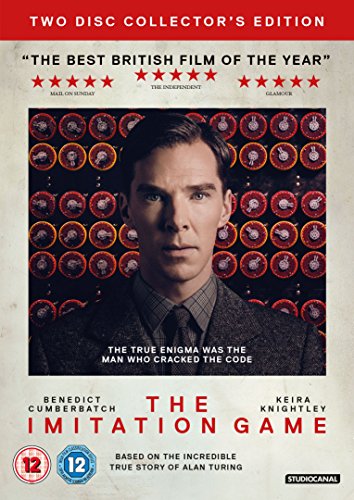
The Oscar-winning film that introduced Turing’s story to millions. This 2-disc collector’s edition includes bonus features on the real history behind the film, at a 4.7-star average across more than 6,000 reviews.
Why Alan Turing Matters More Than Ever in the Age of AI
Every conversation happening today about artificial intelligence — what it can do, what it should be allowed to do, whether it can genuinely "think" — is, whether people realize it or not, still fundamentally framed by questions Turing posed in 1950. The Turing Award, established in 1966 and often called "the Nobel Prize of computing," is computer science’s highest honor, awarded annually to researchers whose work has had lasting, foundational impact on the field — a fitting tribute given that the entire field exists downstream of Turing’s original theoretical insight.
Beyond the theoretical foundations, Turing’s wartime work at Bletchley Park is also credited as a foundational moment in the history of both cryptography and, more broadly, computer security — disciplines that now underpin online banking, private messaging, and national security infrastructure worldwide. It is difficult to identify another single individual whose ideas touch as much of modern digital life, from the phone in your pocket to the AI chatbot you might have talked to this week, as directly as Alan Turing’s do.
Learn More: Recommended Books and Resources
For readers who want to go deeper than any single article can cover, these resources — spanning a definitive adult biography, an illustrated introduction, a technical deep dive, and a hands-on way to experience the codebreaking itself — each approach Turing’s story from a different angle. Whichever one you choose, you will come away understanding not just what Turing did, but why it still matters every single day, whether or not you ever think about him while using the technology he made possible.
For Younger Readers or a Quick Introduction
The Little People, BIG DREAMS series has become a genuinely popular way to introduce complex historical figures to children and curious adults alike, using accessible language and striking illustrated artwork. The Alan Turing entry covers his core achievements — codebreaking and the foundations of computing — in an approachable, age-appropriate way without oversimplifying what made his ideas genuinely important.

A beautifully illustrated introduction to Turing’s life and achievements, perfect for younger readers or anyone who wants an accessible starting point before diving into a full biography. 4.7 stars across 358 reviews.
For Technical Readers
Charles Petzold’s The Annotated Turing takes Turing’s dense, notoriously difficult original 1936 paper and walks readers through it line by line, explaining the mathematics and logic in plain, patient language. It is the single best resource for anyone who wants to actually understand the technical substance behind "On Computable Numbers" rather than just its historical significance — genuinely rewarding for programmers, computer science students, or anyone with a mathematical bent.

A patient, line-by-line walkthrough of Turing’s original 1936 paper for readers who want to understand the actual mathematics and logic behind the Turing machine, not just its historical legacy. 4.6 stars across 398 reviews.
A Hands-On Way to Experience Codebreaking
For a genuinely hands-on way to engage with the spirit of what happened at Bletchley Park, this wooden cipher machine lets you physically encode and decode secret messages by hand — a popular pick for escape-room enthusiasts, STEM classrooms, and family game nights, and a uniquely tactile way to understand, even in a simplified form, the kind of mechanical encryption logic Turing spent years working to defeat.

A hands-on wooden cipher machine that lets you encode and decode secret messages by hand — a tactile, genuinely fun way to engage with the kind of mechanical encryption logic Turing spent years working to break. 4.7 stars.
Frequently Asked Questions
Was Alan Turing really the sole inventor of the computer?
Not the sole inventor in a literal, single-handed sense — computing has many contributors, including Charles Babbage and Ada Lovelace in the 19th century, and engineers like John von Neumann and Presper Eckert in the 20th. What Turing uniquely provided was the theoretical foundation: a rigorous mathematical proof, published in 1936 before any electronic computer existed, that defined the fundamental capabilities and limits of computation itself. This is why he is widely called the "father of computer science and artificial intelligence" rather than simply an inventor of a specific machine — his contribution was conceptual and foundational rather than purely mechanical.
How much did Turing’s codebreaking actually shorten World War II?
Historian Sir Harry Hinsley, who worked at Bletchley Park himself and later wrote the official history of British intelligence in the war, estimated that Ultra intelligence shortened the war in Europe by at least two years, and possibly as many as four. Other historians offer more conservative estimates, but there is broad consensus that the intelligence produced at Bletchley Park, with Turing’s Bombe design at its core, materially altered the outcome and pace of major campaigns including the Battle of the Atlantic, where it helped the Allies locate and avoid German U-boat wolfpacks targeting supply convoys.
Why was Turing’s work kept secret for so long?
The British government considered the methods used to break Enigma to be a uniquely valuable intelligence asset that could still be useful against other countries using similar cipher technology after the war ended. The existence of Ultra, and Bletchley Park’s codebreaking operation as a whole, remained officially classified until the mid-1970s — nearly 20 years after Turing’s death — which meant he lived and died without any public acknowledgment of what many historians now consider one of the most significant individual contributions to Allied victory in the entire war.
Is chemical castration still a legal punishment anywhere today?
The specific criminal offense used to prosecute Turing — "gross indecency" between men — was decriminalized in England and Wales in 1967 and has since been repealed throughout the United Kingdom, and the 2017 "Turing’s Law" retroactively pardoned other men convicted under it. Chemical castration remains a court-ordered or voluntary option in a small number of jurisdictions worldwide today, typically framed very differently — as a treatment option in specific criminal contexts unrelated to consensual adult relationships — but the practice as it was applied to Turing, as a punishment for homosexuality itself, is now widely recognized internationally as a grave historical injustice.
What is the Turing Award, and who has won it?
Established by the Association for Computing Machinery in 1966, the Turing Award is widely considered the highest honor in computer science, often described as the field’s equivalent of the Nobel Prize. Past recipients include foundational figures across programming languages, artificial intelligence, cryptography, and computer architecture — essentially a roll call of the people whose work built the modern digital world, all working in a lineage of ideas that traces directly back to Turing’s own 1936 and 1950 papers.
Did Turing predict modern artificial intelligence?
With striking accuracy, yes. His 1950 paper anticipated not just the eventual existence of machines capable of humanlike conversation, but also many of the philosophical objections people would raise against the idea — objections he addressed and rebutted point by point, decades before anyone could test his ideas against a real system. Modern debates about whether large language models can "really" think, or are simply very sophisticated pattern-matching systems, are, in essence, still the exact debate Turing was already anticipating and engaging with in 1950.
Conclusion: A Debt the World Is Still Repaying
Alan Turing spent his short life solving problems that were, quite literally, ahead of their time — defining computation before computers existed, breaking a code the Germans believed unbreakable, and asking questions about machine intelligence that the world is still working through more than seventy years later. He did all of this while living with a secret that British law made criminal, and he paid for that secret with his career, his health, and ultimately his life, at 41 years old.
Life at Bletchley Park: The People Behind the Codebreaking
Bletchley Park was not a solitary operation, and understanding Turing’s story properly means understanding the remarkable community he worked within. At its peak, nearly 9,000 people worked at Bletchley Park, the majority of them women serving as codebreakers, machine operators, and translators — a workforce whose scale and diversity was itself kept secret for decades. Among Turing’s closest colleagues was Joan Clarke, a brilliant mathematician recruited to Hut 8, the section Turing led, where she quickly became one of the few people capable of working at his level.
Turing and Clarke became close friends and were, for a period, engaged to be married — a relationship Turing entered partly out of genuine affection and partly, by his own later account to her, an attempt to conform to social expectations despite his sexuality. He eventually told her the truth and ended the engagement; remarkably, their friendship survived the disclosure intact, and Clarke went on to a distinguished career of her own in cryptanalysis, remaining one of the relatively few women of her era formally recognized for high-level codebreaking work.
Life inside Bletchley Park combined intense, secretive pressure with an unusual intellectual culture — codebreakers were drawn not just from mathematics but from classics, chess championships, and crossword puzzle competitions, on the theory that unconventional pattern-recognition skills mattered more than formal training. Turing, by most colleagues’ accounts, was a somewhat eccentric presence even within this unusual environment: known for chaining his tea mug to a radiator to prevent theft, cycling to work in a gas mask during high pollen season, and running long distances recreationally at a competitive amateur level, once narrowly missing selection for the British Olympic marathon team.
How the Bombe Actually Worked
The Enigma machine’s apparent unbreakability came from the sheer number of possible settings for its rotors and plugboard — but Turing’s critical insight was that German operators, under wartime pressure and following predictable procedures, made the problem tractable in practice even though it remained astronomically large in theory. German messages often began with predictable phrases, weather reports followed standard formats, and operators sometimes reused settings or made procedural shortcuts — all of which gave codebreakers a toehold.
The Bombe exploited a specific weakness: it searched for a plausible "crib" — a guessed fragment of plaintext — and mechanically tested Enigma rotor and plugboard combinations at high speed, using a chain of logical contradictions to rapidly eliminate impossible settings until a small number of viable candidates remained for human codebreakers to verify by hand. Each Bombe machine was roughly the size of a large wardrobe, filled with rotating drums that physically simulated dozens of Enigma machines simultaneously. By the height of the war, over 200 Bombes were operating across Britain, processing German military traffic on a near-continuous basis — an industrial-scale codebreaking operation built directly from Turing’s theoretical design.
A Turing Life Timeline
- 1912: Born June 23 in Maida Vale, London.
- 1931: Enters King’s College, Cambridge, to study mathematics.
- 1936: Publishes "On Computable Numbers," introducing the concept of the Turing machine.
- 1939: Joins Bletchley Park at the outbreak of World War II.
- 1939-1945: Leads the effort to break German Enigma traffic, designing the Bombe.
- 1945: Awarded an OBE for wartime service; joins the National Physical Laboratory to design the ACE computer.
- 1948: Moves to the University of Manchester to work on the Manchester Mark 1.
- 1950: Publishes "Computing Machinery and Intelligence," introducing the Turing Test.
- 1952: Prosecuted for "gross indecency"; accepts chemical castration over imprisonment.
- 1954: Dies on June 8 at age 41, ruled a suicide by cyanide poisoning.
- 1966: The ACM establishes the Turing Award in his honor.
- 2009: Prime Minister Gordon Brown issues a formal public apology.
- 2013: Queen Elizabeth II grants a posthumous Royal Pardon.
- 2014: The Imitation Game is released, introducing his story to a global audience.
- 2017: "Turing’s Law" retroactively pardons thousands of other men convicted under similar historic laws.
- 2021: Turing’s portrait enters circulation on the Bank of England £50 note.
Turing’s Forgotten Final Chapter: Mathematical Biology
In the last few years of his life, Turing turned his attention away from computing almost entirely and toward a question that, on its surface, seems worlds apart from codebreaking and machine intelligence: why do biological patterns look the way they do? In his 1952 paper "The Chemical Basis of Morphogenesis," he proposed a mathematical model showing how simple chemical reactions between two substances — diffusing and reacting at different rates — could spontaneously generate the complex, repeating patterns seen throughout nature, from the spots on a leopard to the ridges on a seashell to the spacing of a zebra’s stripes.
At the time, this work received relatively little attention, overshadowed both by his more famous computing achievements and by the personal turmoil of his final two years. It took decades for biologists to develop the experimental tools needed to actually test Turing’s reaction-diffusion model against real biological systems — and when they did, starting seriously in the 1990s and continuing today, his equations held up remarkably well. Modern developmental biology now recognizes "Turing patterns" as a genuine, foundational framework for understanding pattern formation in nature, one more example of an idea that arrived years, in this case decades, before the world was equipped to fully appreciate it.
Common Misconceptions About Alan Turing
A few persistent myths about Turing are worth directly addressing, since popular retellings — including, to some degree, The Imitation Game itself — have occasionally blurred historical accuracy in service of a cleaner narrative. First, Turing did not single-handedly build the Bombe from nothing in isolation; he led a team, built on earlier Polish codebreaking work, and worked alongside engineers who turned his design into a functioning machine. This does not diminish his contribution, which was genuinely central and irreplaceable, but the popular image of a lone genius working entirely alone understates the collaborative reality of Bletchley Park.
Second, Turing was not a social recluse or friendless figure, despite sometimes being portrayed that way. Colleagues’ accounts describe an eccentric but warm, well-liked figure with close friendships, a competitive streak in sports and games, and a good sense of humor, even if he also struggled, as many people did in that era and social context, with expressing his full self openly given the very real legal danger of doing so.
Third, while Turing’s prosecution and death are rightly remembered as a profound injustice, it is worth noting that his scientific reputation among mathematicians and early computer scientists never actually vanished the way popular retellings sometimes suggest — his 1936 and 1950 papers continued to be cited and built upon within specialist academic circles throughout the following decades. What was missing for most of that time was public, mainstream recognition of both his wartime heroism and the full human cost he paid for it — a gap that the declassification of Ultra, Andrew Hodges’ biography, and eventually The Imitation Game gradually closed.
The apology, the pardon, and the banknote came decades too late to help the man himself. But they stand today as a rare, deliberate act of a nation publicly correcting a historical wrong — and as a reminder that the person behind almost every technology we now take for granted was, in the end, just that: a person, brilliant and flawed and human, deserving of far better than what he received while he was alive to receive it. It is also, in its own quiet way, a genuinely hopeful story: proof that a society can look honestly at a historical wrong it committed, name it, and work to make what amends are still possible, even generations after the fact. It is also a reminder that recognition does not always arrive on a predictable schedule: sometimes it takes seventy years, an Act of Parliament, and a place on a banknote for a society to finally, fully say thank you.
Want more stories of the inventors and scientists who shaped the modern world? Read our biography of Nikola Tesla, or explore our full library of biographies and inventions.
Looking for more tested tech recommendations? Check out our guides to the best portable chargers and power banks, the best home office monitors, and the best robot vacuums of 2026.
Build your own computer projects: Turing imagined machines that follow instructions. Start programming real hardware with our guide to the best Arduino starter kits for beginners.
Further reading: see the best books about inventors and scientists, including Andrew Hodges’s classic Turing biography.