Affiliate disclosure: TBB 787 is a participant in the Amazon Services LLC Associates Program. If you buy through links on this page, we may earn a small commission at no extra cost to you. Every book was chosen on its merits; no publisher paid to be included.
Behind every invention is a person, and behind every person is a story far more surprising than the tidy version in school textbooks. Thomas Edison tested thousands of materials before finding a practical light bulb filament. The Wright brothers were bicycle mechanics with no college degrees. Marie Curie worked with radioactive materials in a leaky shed. James Dyson built more than five thousand prototypes before his vacuum cleaner worked. The best biographies and histories of invention bring those struggles to life and show how curiosity, persistence, rivalry and luck combine to change the world.
We write about inventors and scientists every week here at TBB 787, and these are the books we recommend most often. This guide collects 30 of the best books about inventors, scientists and the history of invention, organized by theme, with honest notes on what each book covers, how readable it is, and who will enjoy it most. There are sweeping histories, intimate biographies, gripping novels and picture books for young readers, so you will find something here whether you are a lifelong history buff, a student, or buying a gift.
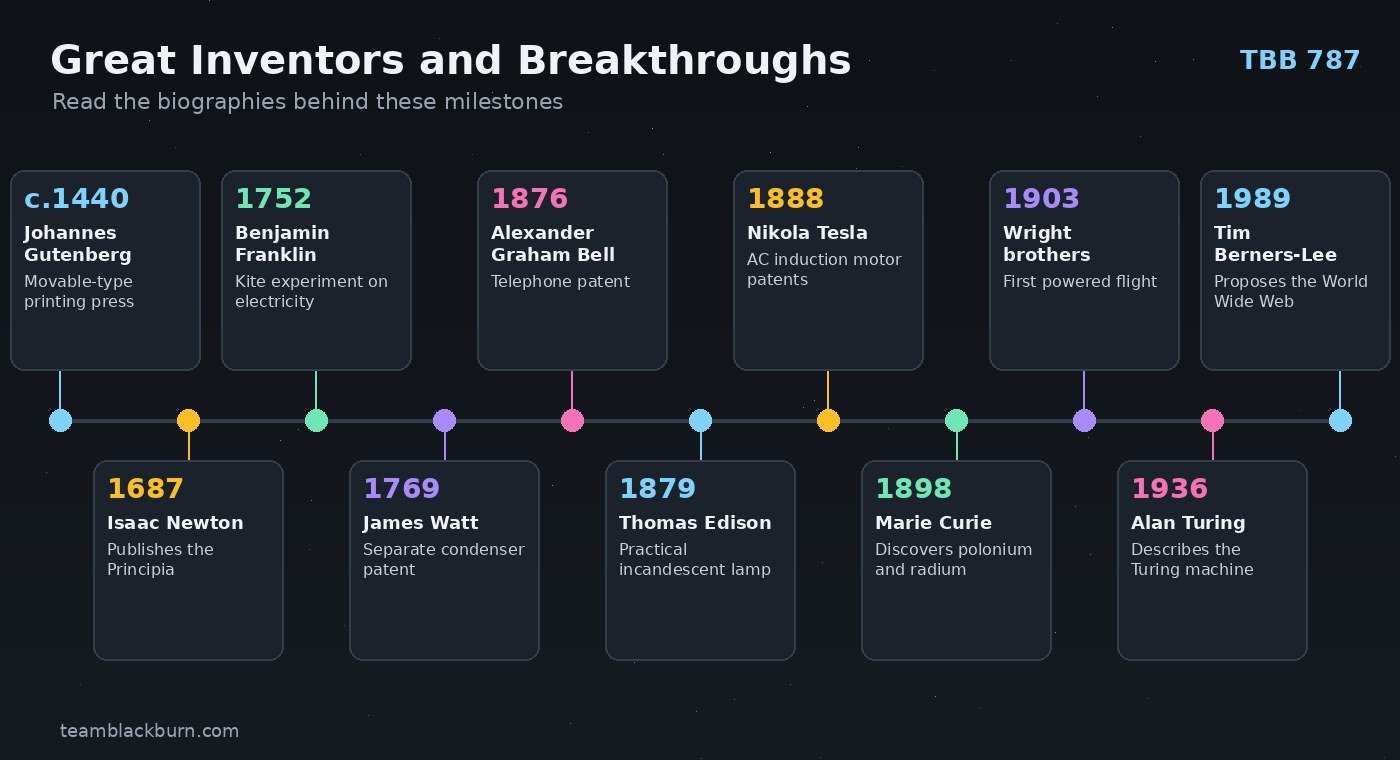
Quick Picks: Our Top 10 Books About Inventors and Scientists
- The Innovators by Walter Isaacson: the best overview of the digital revolution
- The Wright Brothers by David McCullough: the most enjoyable inventor biography
- Tesla: Inventor of the Electrical Age by W. Bernard Carlson: the most reliable Tesla biography
- Einstein: His Life and Universe by Walter Isaacson: the definitive popular Einstein biography
- Longitude by Dava Sobel: a short, gripping story of one invention
- Hidden Figures by Margot Lee Shetterly: the women mathematicians behind the space race
- Alan Turing: The Enigma by Andrew Hodges: the classic Turing biography
- The Idea Factory by Jon Gertner: how Bell Labs invented the modern world
- Leonardo da Vinci by Walter Isaacson: the original Renaissance inventor
- The Boy Who Harnessed the Wind by William Kamkwamba and Bryan Mealer: an inspiring modern inventor story
How We Chose These Books
We selected books based on accuracy and research quality (favoring respected historians and biographers who work from primary sources), readability, lasting reputation among readers and reviewers, and how well each book illuminates the process of invention and discovery, not just the person. We included a mix of classics and more recent titles, and a few books for children and teens. We have noted where a book is a novel or where its author takes a particular point of view.
Why Read About Inventors Today?
We live in a period of extraordinary technological change. Artificial intelligence, gene editing, renewable energy, space launch, and 3D printing are reshaping daily life faster than most people can follow. Reading about earlier waves of invention is one of the best ways to understand the present. The arrival of electricity, the telegraph, the airplane and the computer all brought the same mixture of excitement, fear, hype, competition and unexpected consequences that we see around new technologies today.
Biographies also make science and engineering feel human and achievable. Textbooks present discoveries as finished facts. Good biographies show the messy reality: false starts, arguments, money worries, rivalries, and the long hours of patient experiment that come before a breakthrough. For students, that can be the difference between thinking “I could never do that” and “maybe I could.” For adults, these books are a reminder that curiosity is a habit anyone can practice.
Finally, these stories are simply great reading. The best books on this list have plots as gripping as any novel: races against rivals, wartime secrets, courtroom battles, failures that nearly ended careers, and triumphs that changed history.
Best Histories of Invention
1. The Innovators by Walter Isaacson

Published in 2014, The Innovators tells the story of the digital revolution from Ada Lovelace and Charles Babbage in the nineteenth century through Alan Turing, Grace Hopper, the inventors of the transistor and the microchip, the pioneers of the personal computer and the internet, and the founders of the modern web and search. Isaacson’s central argument is that innovation is usually collaborative: the computer and the internet were built by teams and networks of people, not lone geniuses.
Why read it: It is the best single-volume overview of how computing came to be, packed with vivid portraits and connections between people you may have studied separately. It pairs perfectly with our article on how the internet was invented.
Best for: anyone curious about technology, students, and readers who like big-picture history.
2. How We Got to Now by Steven Johnson
In How We Got to Now (2014), Steven Johnson explores six innovations that made the modern world: glass, cold, sound, clean, time and light. Each chapter follows surprising chains of cause and effect, showing, for example, how improvements in glassmaking led to spectacles, microscopes and telescopes, and eventually to fiber optics. Johnson calls these unexpected connections the “hummingbird effect.”
Why read it: It changes how you see everyday objects and shows how inventions ripple outward in ways their creators never imagined. It is light, fast and endlessly quotable.
Best for: curious general readers and anyone who enjoys “I never knew that” moments.
3. A Short History of Nearly Everything by Bill Bryson
Bill Bryson’s A Short History of Nearly Everything (2003) is a funny, warm tour through the history of science, from the Big Bang and the age of the Earth to atoms, evolution and the origins of life, told largely through the eccentric people who made the discoveries. It is not strictly about inventors, but it is one of the most enjoyable introductions to how we know what we know.
Why read it: Bryson makes science feel like an adventure story, and his portraits of scientists are full of humor and humanity.
Best for: readers who found science dull in school and want a second chance.
4. The Idea Factory by Jon Gertner
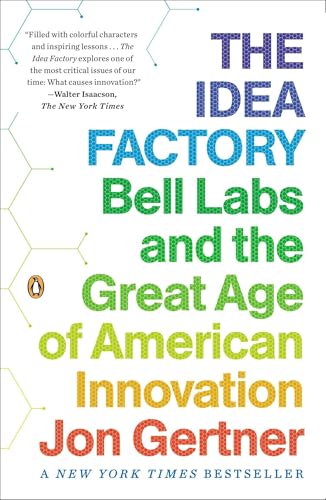
The Idea Factory (2012) tells the story of Bell Labs, the research arm of the old AT&T telephone monopoly, which produced an astonishing run of breakthroughs in the twentieth century, including the transistor in 1947, Claude Shannon’s information theory, early solar cells, and pioneering work on lasers, satellites and software. Gertner focuses on the people and on the management culture that made such productivity possible.
Why read it: It explains where much of modern electronics and communications came from and asks a fascinating question: how do you organize people to invent the future?
Best for: engineers, managers, students of innovation, and anyone who uses a smartphone.
Electricity and the Age of Invention
5. Tesla: Inventor of the Electrical Age by W. Bernard Carlson

Nikola Tesla attracts more myths than almost any other inventor. In Tesla: Inventor of the Electrical Age (2013), historian of technology W. Bernard Carlson separates the real Tesla from the legend, explaining how his alternating current motor and related inventions worked, how he promoted his ideas, how he financed them, and why some of his grandest projects failed.
Why read it: It is careful, balanced and grounded in documents, which makes it the best choice if you want to understand Tesla’s actual achievements. It complements our own Nikola Tesla biography.
Best for: serious readers and anyone tired of internet Tesla myths.
6. Wizard: The Life and Times of Nikola Tesla by Marc J. Seifer
Wizard (first published in 1996) is a long, richly detailed biography that covers Tesla’s personal life, his relationships, his inventions and his later years. It is more expansive and more speculative in places than Carlson’s book, but it gathers an enormous amount of material.
Why read it: For Tesla enthusiasts who want every detail after reading a more focused biography first.
Best for: dedicated Tesla fans.
7. Edison by Edmund Morris
Edmund Morris, the Pulitzer Prize-winning biographer of Theodore Roosevelt, spent years on Edison (2019), which was published shortly after his death. Unusually, it is told in reverse chronological order, starting with Edison’s final years and working back to his childhood, which some readers love and others find challenging. Morris covers Edison’s astonishing range of work, from the phonograph and electric light to motion pictures, batteries and rubber research.
Why read it: Few books capture the sheer scale of Edison’s work as an organizer of invention, and Morris’s prose is excellent.
Best for: readers who enjoy literary biography and do not mind an unusual structure.
8. Empires of Light by Jill Jonnes

Empires of Light (2003) tells the story of the race to electrify the world in the late nineteenth century, focusing on Thomas Edison, Nikola Tesla and George Westinghouse, and the bitter “War of the Currents” between direct current and alternating current.
Why read it: It shows the business, rivalry and public spectacle behind one of the most important technological transitions in history, and it brings all three men to life in one narrative.
Best for: readers who want the Edison versus Tesla story in a single, readable history.
9. The Last Days of Night by Graham Moore (Novel)
Graham Moore, who won an Academy Award for writing the screenplay of The Imitation Game, turned the War of the Currents into a historical thriller in The Last Days of Night (2016). It follows the young lawyer Paul Cravath as he represents George Westinghouse against Thomas Edison in a massive patent fight, with Tesla as a key character.
Why read it: It is a fast, entertaining way into the history, although it is fiction and takes liberties with events and timelines. Read it alongside a nonfiction book to separate fact from invention.
Best for: readers who prefer novels and want an exciting introduction.
10. Benjamin Franklin: An American Life by Walter Isaacson
Before he was a Founding Father, Benjamin Franklin was one of the most famous scientists and inventors of the eighteenth century, known for his experiments with electricity and inventions such as the lightning rod, bifocal glasses and the Franklin stove. Isaacson’s Benjamin Franklin: An American Life (2003) covers Franklin as a scientist, writer, businessman and diplomat.
Why read it: Franklin’s practical, experimental mind is a great example of how curiosity and invention served public life.
Best for: American history readers and fans of practical inventors.
11. The Victorian Internet by Tom Standage
In The Victorian Internet (1998), Tom Standage argues that the telegraph was the nineteenth century’s internet, a communication network that transformed business, news, diplomacy and even romance, complete with hackers, scams and online-style romances conducted in Morse code.
Why read it: It is short, witty and full of surprising parallels with today’s technology, showing that many debates about new communication tools are very old. It sets up the story we tell about the invention of the telephone.
Best for: anyone interested in communication technology and its social effects.
Physics, Mathematics and the Great Scientists
12. Einstein: His Life and Universe by Walter Isaacson
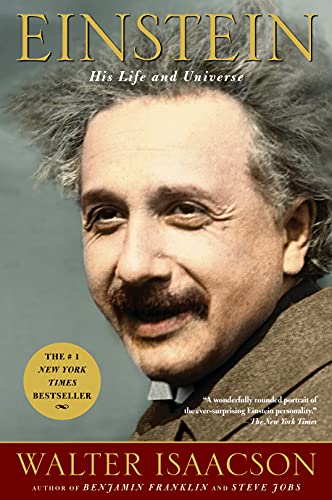
Isaacson’s Einstein: His Life and Universe (2007) draws on Einstein’s personal letters, which became available to researchers shortly before the book was written, to tell the story of the patent clerk who transformed physics. It explains special and general relativity accessibly and gives a full portrait of Einstein’s family life, politics and later years.
Why read it: It balances science and humanity better than almost any other Einstein biography. For a shorter introduction, see our Albert Einstein biography.
Best for: general readers and students.
13. Isaac Newton by James Gleick
James Gleick’s Isaac Newton (2003) is a compact, elegant biography of the man who described gravity and the laws of motion and helped invent calculus. Gleick draws heavily on Newton’s own notebooks to portray a secretive, brilliant and difficult person.
Why read it: It is short enough to read in a weekend but rich in insight. Pair it with our Isaac Newton article.
Best for: readers who want depth without a doorstop of a book.
14. Genius: The Life and Science of Richard Feynman by James Gleick
Richard Feynman was a Nobel Prize-winning physicist, a legendary teacher, a member of the Manhattan Project, and a key voice on the commission investigating the 1986 Challenger disaster. Gleick’s Genius (1992) explains both Feynman’s science and his playful, iconoclastic personality.
Why read it: It is one of the best portraits of how a great scientist actually thinks.
Best for: physics fans and anyone curious about creativity in science.
15. “Surely You’re Joking, Mr. Feynman!”

“Surely You’re Joking, Mr. Feynman!” (1985) is a collection of hilarious autobiographical stories told by Feynman to his friend Ralph Leighton: safecracking at Los Alamos, learning to draw, playing drums in Brazil, and puzzling out problems for the fun of it.
Why read it: It is funny, inspiring and has convinced countless readers that science can be an adventure. Note that some anecdotes reflect attitudes of their era that modern readers may find dated.
Best for: teens and adults looking for an entertaining, inspiring read.
16. The Man Who Knew Infinity by Robert Kanigel
The Man Who Knew Infinity (1991) tells the story of Srinivasa Ramanujan, the self-taught Indian mathematician who sent astonishing results to the Cambridge mathematician G. H. Hardy, traveled to England, and produced work that mathematicians still study today, before his early death. It was adapted into a film released in 2015.
Why read it: It is a moving story about genius, friendship, culture and persistence.
Best for: readers interested in mathematics and in stories of unlikely brilliance.
Computing and the Information Age
17. Alan Turing: The Enigma by Andrew Hodges

Andrew Hodges’s Alan Turing: The Enigma (first published in 1983) is the classic biography of the mathematician who described the theoretical basis of modern computers, helped break German codes at Bletchley Park during the Second World War, and was later persecuted for being gay. It served as the basis for the 2014 film The Imitation Game.
Why read it: It is thorough and authoritative, covering Turing’s mathematics, wartime work and tragic later life. It is long and detailed, so pair it with our shorter Alan Turing biography if you want an overview first.
Best for: committed readers interested in computing and codebreaking.
18. The Dream Machine by M. Mitchell Waldrop
The Dream Machine (2001, reissued in recent years) tells the story of J. C. R. Licklider, a psychologist and computer visionary who imagined interactive, networked computing long before it existed and helped fund the research that led to the ARPANET, the precursor of the internet.
Why read it: It fills in a crucial, often overlooked chapter of computing history and shows how a visionary funder can shape a technological revolution.
Best for: readers who enjoyed The Innovators and want to go deeper.
Flight, Engineering and Problem Solving
19. The Wright Brothers by David McCullough
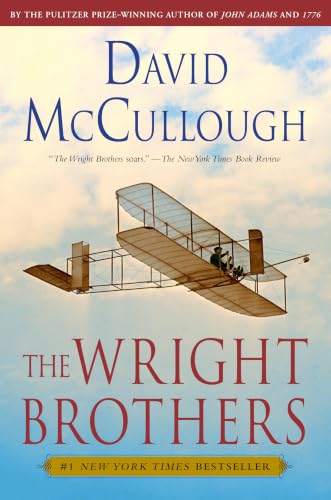
Two-time Pulitzer Prize winner David McCullough’s The Wright Brothers (2015) tells how Wilbur and Orville Wright, bicycle makers from Dayton, Ohio, studied birds, built a wind tunnel, tested gliders on the dunes of Kitty Hawk, and made the first powered, controlled airplane flight on December 17, 1903. McCullough draws on the family’s letters and diaries.
Why read it: It is beautifully written, warm and inspiring, and it captures the patience and methodical experimentation behind a world-changing invention.
Best for: almost everyone; one of the most enjoyable inventor biographies ever written.
20. Longitude by Dava Sobel

For centuries, sailors could not reliably determine their longitude at sea, and ships were wrecked as a result. In Longitude (1995), Dava Sobel tells how John Harrison, a self-taught clockmaker, spent decades building increasingly precise marine timekeepers to solve the problem, battling skeptical scientists along the way.
Why read it: It is short, suspenseful and one of the best popular books ever written about a single invention.
Best for: busy readers who want a complete, gripping story in a few evenings.
21. Brunelleschi’s Dome by Ross King
In the early fifteenth century, Florence had a cathedral with a gaping hole where a dome should be, and nobody knew how to build one that large. Brunelleschi’s Dome (2000) tells how the goldsmith and clockmaker Filippo Brunelleschi designed ingenious machines and building techniques to construct the dome without the massive wooden centering, the temporary support frame normally used to build arches and domes.
Why read it: It shows that invention is not only about gadgets; engineering methods and machines were just as revolutionary. It is a great companion to our Leonardo da Vinci biography.
Best for: architecture, engineering and Renaissance history fans.
22. Invention: A Life by James Dyson
In Invention: A Life (2021), British inventor James Dyson tells his own story, including the 5,127 prototypes he built before his bagless vacuum cleaner worked, years of rejection from manufacturers, and his views on engineering education and failure.
Why read it: It is a rare first-person account of the modern invention process, from prototyping and patents to manufacturing and business. Keep in mind it is an autobiography with its author’s own perspective.
Best for: aspiring inventors, entrepreneurs and engineering students.
Women in Science and Invention
23. Obsessive Genius: The Inner World of Marie Curie by Barbara Goldsmith
Obsessive Genius (2005) is a concise, readable biography of Marie Curie, the first woman to win a Nobel Prize and the first person to win Nobel Prizes in two different sciences. It covers her discovery of polonium and radium with Pierre Curie, her pioneering research on radioactivity, and the personal costs of her work.
Why read it: It is an excellent introduction to Curie’s life and science in a manageable length. See also our Marie Curie biography.
Best for: students and general readers.
24. Hidden Figures by Margot Lee Shetterly
Hidden Figures (2016) tells the true story of the Black women mathematicians, including Katherine Johnson, Dorothy Vaughan and Mary Jackson, who worked as “human computers” at NASA’s Langley Research Center and contributed to aeronautics and the space race despite segregation and discrimination. It inspired the 2016 film of the same name, and there is also a Young Readers’ Edition.
Why read it: It restores important people to the history of spaceflight and shows how much talent was overlooked. It connects to our history of the Space Race.
Best for: readers interested in space history and civil rights.
25. Hedy’s Folly by Richard Rhodes
Hedy Lamarr was a Hollywood star, but she was also an inventor. In Hedy’s Folly (2011), Pulitzer Prize-winning author Richard Rhodes tells how Lamarr and the composer George Antheil developed a frequency-hopping system intended to protect radio-guided torpedoes from jamming, receiving a patent in 1942, an idea related to techniques later used in modern wireless communication.
Why read it: It is a fascinating, unexpected story of creativity crossing boundaries between art and engineering.
Best for: readers who love surprising stories behind everyday technology.
26. The Code Breaker by Walter Isaacson
The Code Breaker (2021) follows Jennifer Doudna and the race to develop CRISPR gene editing, the technology for which Doudna and Emmanuelle Charpentier shared the 2020 Nobel Prize in Chemistry. Isaacson explains the science and explores the ethical questions raised by editing the genetic code.
Why read it: It shows invention happening in our own time and raises important questions about the future. It pairs well with our history of vaccines.
Best for: readers interested in biology, medicine and ethics.
The Original Renaissance Inventor
27. Leonardo da Vinci by Walter Isaacson
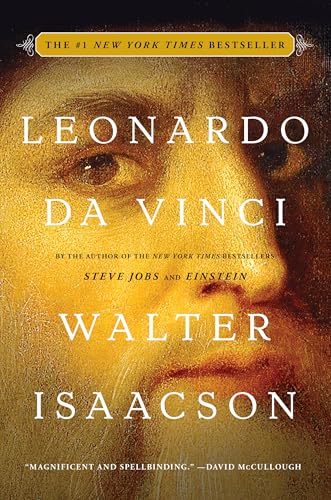
Isaacson’s Leonardo da Vinci (2017) is built around Leonardo’s surviving notebooks, thousands of pages filled with observations, inventions, anatomical drawings and to-do lists. It portrays Leonardo as a relentlessly curious observer whose art and engineering grew from the same habit of looking closely.
Why read it: It is lavishly illustrated in hardcover and full of lessons about curiosity that apply to anyone. It is one of the most popular biographies of the past decade.
Best for: art lovers, inventors and anyone who wants to be more curious.
Best Books About Inventors for Kids and Teens
28. The Boy Who Harnessed the Wind by William Kamkwamba and Bryan Mealer
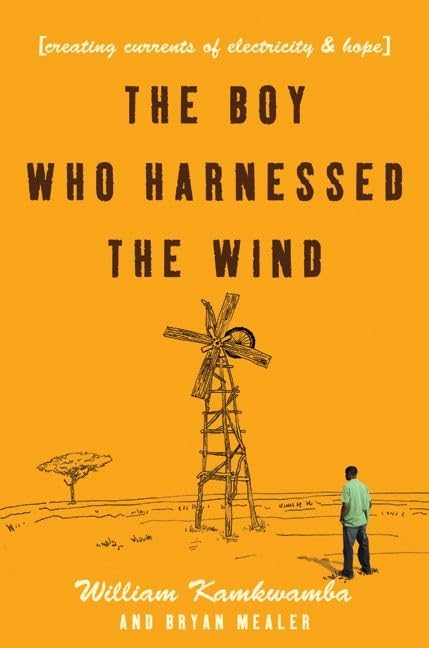
During a famine in Malawi, teenager William Kamkwamba, forced to leave school, taught himself from library books and built a working windmill from scrap parts to bring electricity to his family’s home. The Boy Who Harnessed the Wind (2009) tells his story, which later became a 2019 film. There are also Young Readers’ and picture book editions.
Why read it: It is one of the most inspiring modern inventor stories, perfect for teens and families.
Best for: teens, families and classrooms.
29. Who Was Albert Einstein? and Who Was Marie Curie?
The popular “Who Was” series offers short, illustrated biographies for readers around 8 to 12. Who Was Albert Einstein? and Who Was Marie Curie? are great first biographies that make big ideas approachable, and the series includes many other inventors and scientists.
Best for: elementary and middle school readers.
30. Rosie Revere, Engineer and Ada Twist, Scientist by Andrea Beaty
For the youngest readers, Andrea Beaty and illustrator David Roberts created rhyming picture books about curious kids who invent and experiment. Rosie Revere, Engineer celebrates learning from failure, and Ada Twist, Scientist celebrates asking questions and testing ideas.
Best for: ages 4 to 8 and as gifts for young makers.
More Books for Young Inventors
If your child loves the picks above, these titles keep the inspiration going. They are especially good for building a “growth mindset,” the idea that skills improve with effort and that mistakes are part of learning.
- The Most Magnificent Thing by Ashley Spires: a picture book about a girl who sets out to build something amazing, gets frustrated when it does not work, and learns to keep going. It is a perfect read for kids who give up easily.
- What Do You Do With an Idea? by Kobi Yamada: a gentle, beautifully illustrated story about nurturing a new idea even when others doubt it.
- Iggy Peck, Architect by Andrea Beaty: from the same series as Rosie Revere and Ada Twist, about a boy who loves to build.
- Who Were the Wright Brothers? and Who Was Thomas Alva Edison?: more titles from the popular “Who Was” biography series for readers around 8 to 12.
Reading these books aloud and then building something together, even a cardboard invention or a simple circuit, is one of the best ways to turn a story into a lasting interest. Our STEM kits by age group guide has hands-on ideas to pair with them.
Honorable Mentions: Six More Great Reads
These books narrowly missed our main list but are well worth your time, especially once you have read a few of the titles above.
- The Making of the Atomic Bomb by Richard Rhodes (1986): a Pulitzer Prize-winning history of the physics and the people behind nuclear fission and the Manhattan Project. It is long but extraordinary, explaining both the science and its enormous moral consequences.
- The Soul of a New Machine by Tracy Kidder (1981): a Pulitzer Prize-winning account of an engineering team racing to build a new minicomputer. It remains one of the best books ever written about what engineering work actually feels like.
- Galileo’s Daughter by Dava Sobel (1999): the story of Galileo told partly through the surviving letters of his daughter, a nun, offering an intimate view of the scientist and his conflicts with the Church.
- Rosalind Franklin: The Dark Lady of DNA by Brenda Maddox (2002): a biography of the scientist whose X-ray diffraction images were crucial to discovering the structure of DNA, and whose contribution was long underappreciated.
- The Double Helix by James D. Watson (1968): a famous, controversial first-person account of the race to discover DNA’s structure. It is lively and important historically, but read it critically, ideally alongside the Rosalind Franklin biography above, because its portrayal of Franklin has been widely criticized.
- Steve Jobs by Walter Isaacson (2011): the authorized biography of the Apple co-founder, a vivid study of product design, ambition and a complicated personality.
Seven Lessons From the Lives of Great Inventors
Read enough of these books and patterns start to emerge. These lessons appear again and again, and they apply to students, entrepreneurs and anyone trying to solve a hard problem.
- Failure is part of the process. Edison’s teams tested enormous numbers of materials, the Wright brothers crashed gliders and rebuilt them, and Dyson built thousands of prototypes. Inventors treat failures as data, not verdicts.
- Collaboration beats the lone genius. Bell Labs, the Manhattan Project, NASA’s human computers and the teams behind the computer and the internet show that most breakthroughs come from groups of people building on each other’s work.
- Curiosity crosses boundaries. Leonardo combined art and anatomy, Hedy Lamarr combined film and radio engineering, and Franklin combined printing, politics and electrical science. Many breakthroughs happen where different fields meet.
- Measurement and method matter. The Wright brothers’ wind tunnel data and John Harrison’s obsession with precision show that careful experimentation often matters more than inspiration.
- Timing and infrastructure shape success. Inventions succeed when the materials, manufacturing and markets are ready. Many inventors had the right idea too early.
- Business is part of invention. Patents, investors, manufacturing and competition decided the fates of Edison, Tesla and Westinghouse as much as technical brilliance did.
- Every invention raises ethical questions. From the atomic bomb to gene editing, the most powerful inventions force society to make difficult choices about how they are used.
Films and Documentaries to Pair With These Books
Watching a film or documentary can bring a book to life and is a great way to interest reluctant readers. Remember that dramatized films take creative liberties.
- The Imitation Game (2014): a dramatized film about Alan Turing based on Hodges’s biography.
- Hidden Figures (2016): the film adaptation of Shetterly’s book about NASA’s Black women mathematicians.
- The Man Who Knew Infinity (2015): the film version of Ramanujan’s story.
- The Boy Who Harnessed the Wind (2019): a film adaptation of William Kamkwamba’s memoir.
- The Current War: a dramatized film about Edison, Westinghouse and Tesla, released in 2019 after premiering in 2017.
- Radioactive: a dramatized film about Marie Curie released in 2020.
- PBS American Experience documentaries: the series has produced documentaries on inventors including Edison and Tesla that pair well with the biographies above.
Building a Home Library of Invention
If you want a small shelf of books that covers the history of invention from the Renaissance to today, start with five: Leonardo da Vinci for the Renaissance, Longitude for the Age of Exploration, Empires of Light for the age of electricity, The Wright Brothers for the dawn of flight, and The Innovators for the digital age. Add Hidden Figures and Obsessive Genius to include voices that history too often left out, and a kids’ title or two for younger family members. That collection makes a wonderful foundation for curious families, homeschoolers and anyone who loves the stories behind the things we use every day.
All 30 Books at a Glance
| Book | Author | First Published | Best For |
|---|---|---|---|
| The Innovators | Walter Isaacson | 2014 | Digital history overview |
| How We Got to Now | Steven Johnson | 2014 | Surprising chains of innovation |
| A Short History of Nearly Everything | Bill Bryson | 2003 | Fun introduction to science |
| The Idea Factory | Jon Gertner | 2012 | How Bell Labs invented modern tech |
| Tesla: Inventor of the Electrical Age | W. Bernard Carlson | 2013 | Reliable Tesla biography |
| Wizard | Marc J. Seifer | 1996 | Detailed Tesla biography |
| Edison | Edmund Morris | 2019 | Literary Edison biography |
| Empires of Light | Jill Jonnes | 2003 | Edison, Tesla and Westinghouse |
| The Last Days of Night | Graham Moore | 2016 | Historical novel |
| Benjamin Franklin: An American Life | Walter Isaacson | 2003 | Franklin as scientist and inventor |
| The Victorian Internet | Tom Standage | 1998 | The telegraph revolution |
| Einstein: His Life and Universe | Walter Isaacson | 2007 | Definitive popular Einstein |
| Isaac Newton | James Gleick | 2003 | Short, elegant Newton |
| Genius | James Gleick | 1992 | Feynman’s life and science |
| “Surely You’re Joking, Mr. Feynman!” | Richard Feynman with Ralph Leighton | 1985 | Entertaining anecdotes |
| The Man Who Knew Infinity | Robert Kanigel | 1991 | Ramanujan’s story |
| Alan Turing: The Enigma | Andrew Hodges | 1983 | Classic Turing biography |
| The Dream Machine | M. Mitchell Waldrop | 2001 | Licklider and networked computing |
| The Wright Brothers | David McCullough | 2015 | Most enjoyable inventor biography |
| Longitude | Dava Sobel | 1995 | Short, gripping single invention |
| Brunelleschi’s Dome | Ross King | 2000 | Renaissance engineering |
| Invention: A Life | James Dyson | 2021 | Modern inventor’s memoir |
| Obsessive Genius | Barbara Goldsmith | 2005 | Concise Marie Curie |
| Hidden Figures | Margot Lee Shetterly | 2016 | NASA’s human computers |
| Hedy’s Folly | Richard Rhodes | 2011 | Hedy Lamarr the inventor |
| The Code Breaker | Walter Isaacson | 2021 | CRISPR and gene editing |
| Leonardo da Vinci | Walter Isaacson | 2017 | Curiosity and invention |
| The Boy Who Harnessed the Wind | William Kamkwamba and Bryan Mealer | 2009 | Inspiring for teens |
| Who Was Albert Einstein? / Who Was Marie Curie? | Who HQ series | Various | Ages 8 to 12 |
| Rosie Revere, Engineer / Ada Twist, Scientist | Andrea Beaty | 2013 / 2016 | Ages 4 to 8 |
Where to Start: Reading Paths
Thirty books is a lot. If you are not sure where to begin, try one of these reading paths. Each takes you from an accessible introduction to deeper reading.
The electricity path
Start with Empires of Light for the big story of Edison, Tesla and Westinghouse. Then read Tesla: Inventor of the Electrical Age for the most reliable account of Tesla, and finish with Morris’s Edison. If you enjoy fiction, add The Last Days of Night as a fun detour. Our articles on Nikola Tesla and Alexander Graham Bell make good starting points before you dive in.
The computing path
Begin with The Innovators for the overview, then read Alan Turing: The Enigma for the theoretical foundations, The Idea Factory for the transistor and information theory, and The Dream Machine for the road to the internet.
The physics path
Read Gleick’s short Isaac Newton, then Isaacson’s Einstein, then relax with “Surely You’re Joking, Mr. Feynman!” before tackling Gleick’s Genius. Add our article on Stephen Hawking to bring the story into modern cosmology.
The “how inventions happen” path
Start with How We Got to Now, then Longitude and The Wright Brothers as case studies in persistence and experimentation, and finish with Dyson’s Invention: A Life for a modern, first-person account.
The hidden heroes path
Read Hidden Figures, Hedy’s Folly, Obsessive Genius and The Man Who Knew Infinity for stories of brilliant people who faced barriers and are too often left out of the popular story of science.
How to Read a Biography Critically
Biographies are not neutral. Every author chooses what to include and how to interpret it, and popular stories about inventors are full of myths. These habits will make you a smarter reader.
- Check the author’s sources. Good biographies cite letters, notebooks, patents and archives in their notes. Look at the back of the book to see what the author relied on.
- Watch for the “lone genius” myth. Inventions almost always build on earlier work and involve many contributors. Be skeptical of stories in which one person single-handedly changes everything.
- Separate legend from evidence. Famous anecdotes, like Newton’s apple or Edison’s quotes, may be exaggerated or unverifiable. Good biographers tell you when a story is uncertain.
- Compare more than one account. Reading two biographies of the same person, such as Carlson and Seifer on Tesla, shows how interpretations differ.
- Notice what is missing. Ask whose contributions are left out: assistants, partners, spouses, and people whose work was ignored because of their gender, race or class.
- Distinguish fiction from history. Historical novels are wonderful entry points, but they invent dialogue and rearrange events.
Print, Kindle or Audiobook?
Many of these books are available in hardcover, paperback, Kindle and audiobook editions. Illustrated books such as Leonardo da Vinci are best in print, where you can enjoy the images. Narrative histories like The Wright Brothers, Longitude and Hidden Figures work beautifully as audiobooks for commutes and road trips. Kindle editions are handy for long biographies and let you search names and terms. Amazon product pages usually show all available formats, so you can choose the one that fits how you read.
Books as Gifts
Books about inventors make thoughtful, lasting gifts. Pair a biography with a related object for a memorable present: The Wright Brothers with a model airplane kit, Longitude with a classic watch or compass, a Tesla biography with a plasma ball, or Leonardo da Vinci with a sketchbook. For young readers, pair Rosie Revere, Engineer or Ada Twist, Scientist with a simple building or science kit. Our guide to the 50 best gifts for science lovers has many more ideas, and young tinkerers may enjoy one of the best Arduino starter kits after reading about the inventors who came before them.
Meet the Biographers
A handful of authors appear several times on this list because they are exceptionally good at explaining science and invention through human stories.
- Walter Isaacson is a former editor of Time magazine and former CEO of CNN and the Aspen Institute. His biographies of Franklin, Einstein, Leonardo, Jobs and Doudna, along with The Innovators, focus on creativity and on how innovators combine science, art and imagination.
- James Gleick is a science writer known for Chaos and The Information, as well as his biographies of Newton and Feynman. He excels at making difficult scientific ideas understandable without dumbing them down.
- Dava Sobel is a former science reporter for The New York Times whose short, elegant books, including Longitude and Galileo’s Daughter, turned the history of science into bestselling storytelling.
- David McCullough, who died in 2022, was one of America’s most beloved historians, winning two Pulitzer Prizes. His warm, narrative style made history accessible to millions of readers.
- Richard Rhodes won the Pulitzer Prize for The Making of the Atomic Bomb and writes deeply researched histories of science and technology.
Book Club Discussion Questions
Many of these books make excellent book club, classroom or family reading choices. These questions work for almost any book on the list.
- What problem was the inventor or scientist trying to solve, and why did it matter at the time?
- What personal qualities helped them succeed, and which qualities made their lives or work harder?
- Who else contributed to the breakthrough, and do you think they received enough credit?
- How did money, business, competition or politics shape the outcome?
- What failures or setbacks did the inventor face, and how did they respond?
- How did the invention change everyday life, and were there unintended consequences?
- Which popular myths about this person did the book confirm or challenge?
- If this person were alive today, what problem do you think they would work on?
- What is one habit or idea from this book you could apply to your own work or studies?
Best Books by Reader Age
- Ages 4 to 8: Rosie Revere, Engineer; Ada Twist, Scientist.
- Ages 8 to 12: Who Was Albert Einstein?; Who Was Marie Curie?; Young Readers’ Edition of Hidden Figures; Young Readers’ Edition of The Boy Who Harnessed the Wind.
- Teens: The Boy Who Harnessed the Wind; “Surely You’re Joking, Mr. Feynman!”; Longitude; The Wright Brothers; Hidden Figures.
- Adults new to the topic: The Wright Brothers; Longitude; How We Got to Now; A Short History of Nearly Everything.
- Adults wanting depth: The Innovators; Einstein; Alan Turing: The Enigma; Tesla: Inventor of the Electrical Age; The Idea Factory; The Making of the Atomic Bomb.
Frequently Asked Questions
What is the best book about inventors?
For a broad overview of modern invention, The Innovators by Walter Isaacson is our top pick. For a single inventor biography that almost everyone enjoys, choose The Wright Brothers by David McCullough. For a short, gripping read, choose Longitude by Dava Sobel.
What is the best biography of Nikola Tesla?
Tesla: Inventor of the Electrical Age by W. Bernard Carlson is the most balanced, carefully researched choice. Wizard by Marc J. Seifer is longer and more detailed. For the Edison and Westinghouse rivalry, read Empires of Light.
What are good books about famous scientists for kids?
The “Who Was” series, including Who Was Albert Einstein? and Who Was Marie Curie?, is excellent for ages 8 to 12. For younger children, Ada Twist, Scientist and Rosie Revere, Engineer are favorites. Teens will enjoy The Boy Who Harnessed the Wind and the Young Readers’ Edition of Hidden Figures.
Which Walter Isaacson book should I read first?
If you love technology, start with The Innovators. If you prefer science and physics, start with Einstein. If you are drawn to art and curiosity, start with Leonardo da Vinci.
Are these books suitable for students?
Yes. Most are well researched and widely used for school projects and further reading. Check the age suitability of longer adult biographies for younger students, and use the young readers’ editions where available.
Is The Last Days of Night a true story?
It is a historical novel based on real people and the real patent battles between Edison and Westinghouse, but the author invents dialogue and adjusts timelines. Read it for entertainment and pair it with a nonfiction history.
What book explains how inventions actually happen?
How We Got to Now explains how innovations ripple through history, The Idea Factory shows how a research organization produced breakthroughs, and James Dyson’s Invention: A Life describes the modern prototyping and business process from the inside.
Final Thoughts
The stories of inventors and scientists are some of the most inspiring stories humanity has. They show that world-changing ideas usually come from curiosity, stubborn persistence and collaboration rather than sudden flashes of genius, and that many of history’s greatest contributors were people the world almost overlooked. Whether you start with The Wright Brothers, The Innovators, Carlson’s Tesla or Longitude, you will come away seeing the objects around you, from light bulbs to smartphones, in a completely new way.
And when you finish a book, explore the biographies here on TBB 787, including Charles Darwin, James Watt and Johannes Gutenberg, to keep the story going.